Table of Contents
Why This Comparison Matters in 2026– Ford F-150 vs Tesla Model Y
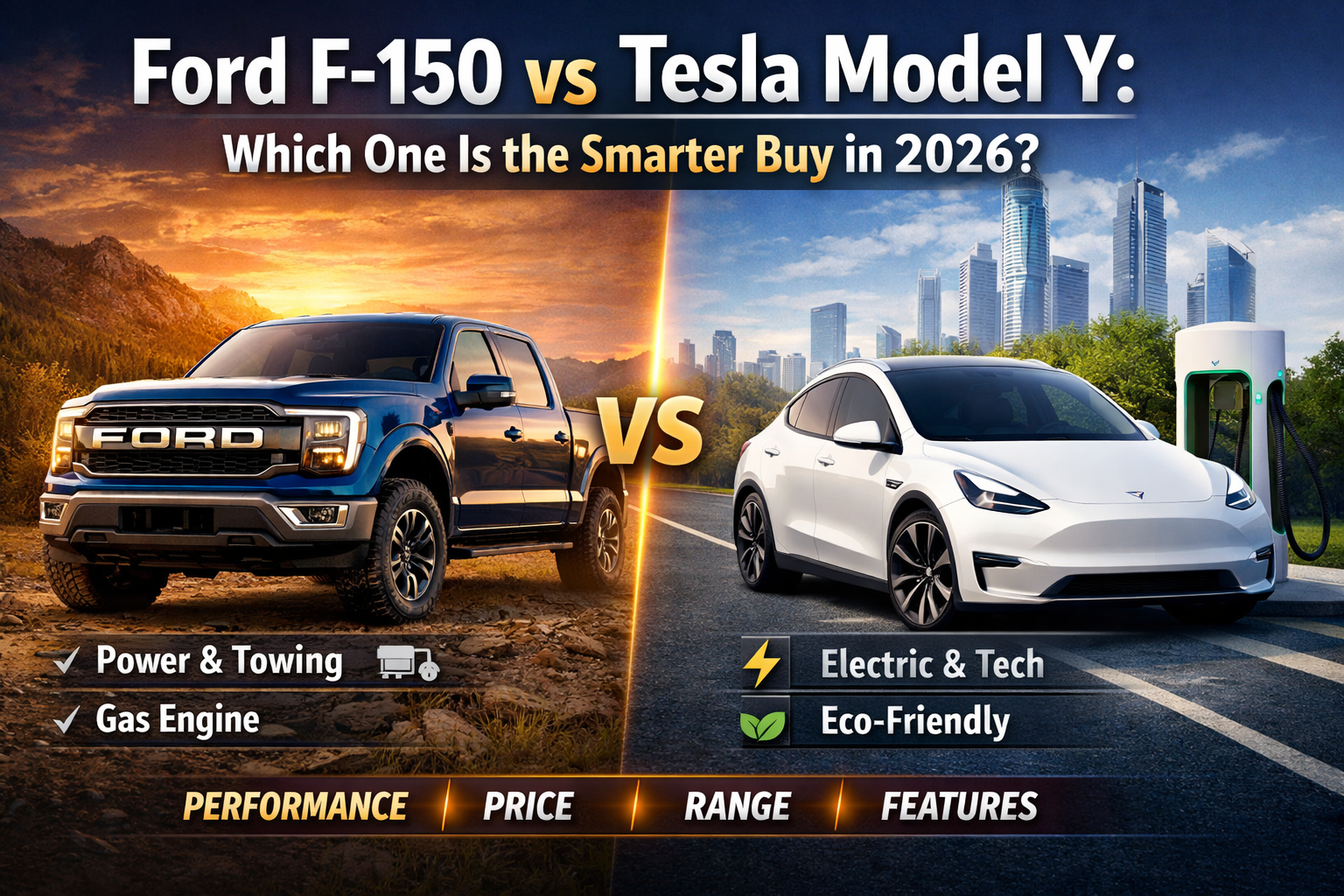
Walk through any American parking lot in 2026 and you’ll see two worlds colliding. On one side, rugged pickup trucks that built the country’s highways, farms, and small businesses. On the other, silent electric SUVs that represent the future of clean mobility. Few vehicles symbolize this shift better than the Ford F-150 and the Tesla Model Y.
The F-150 has been America’s best-selling truck for decades, trusted for hauling, towing, and everyday durability. The Model Y, meanwhile, has become one of the most popular electric vehicles in the country, loved for its tech, low running costs, and futuristic appeal.
If you’re shopping for a new vehicle in 2026, you may be wondering:
Should you stick with traditional power and versatility, or embrace electric efficiency and smart tech?
This article breaks down the real-world differences to help you make a confident, informed decision.
Real-World Usefulness & Buyer Perspective
Before comparing specs and features, it’s important to look at how these vehicles actually fit into daily life.
The Ford F-150 appeals to people who need strength and flexibility. Contractors, outdoor enthusiasts, families with boats or campers, and anyone who frequently hauls gear rely on its towing capacity and open bed. It’s also surprisingly comfortable for commuting and road trips.
The Tesla Model Y targets urban and suburban drivers who want low fuel costs, quiet driving, and advanced technology. It’s ideal for commuting, school runs, weekend trips, and people who can charge at home or work.
Both vehicles are excellent — but for very different lifestyles. Choosing wisely means matching the vehicle to how you really drive, not just what looks cool in ads.
Design & Styling
Ford F-150:
The F-150 looks bold and muscular. Its large grille, tall stance, and wide body give it a commanding presence on the road. It feels like a true American truck — tough, confident, and ready for work. Buyers can choose from multiple trims, from basic work trucks to luxury versions with chrome accents and premium wheels.
Tesla Model Y:
The Model Y has a clean, minimalist design. Smooth curves, flush door handles, and a glass roof give it a modern, futuristic look. It’s compact compared to the F-150, making it easier to park in cities and tight garages.
Interior & Comfort
Ford F-150:
Inside, newer F-150 models feel more like a luxury SUV than a truck. Higher trims offer leather seats, large touchscreens, digital dashboards, heated and ventilated seats, and plenty of storage. The cabin is spacious, especially for rear passengers.
Tesla Model Y:
The Model Y keeps things simple. Almost everything is controlled through a large central touchscreen. The cabin feels airy thanks to the panoramic glass roof. Seating is comfortable, but some drivers miss physical buttons. Cargo space is excellent for an SUV, especially with the rear seats folded.
Engine & Performance
Ford F-150:
The F-150 offers multiple engine choices, including turbocharged gas engines and hybrid options. Power delivery is strong, especially when towing or carrying heavy loads. Acceleration is confident for a vehicle of its size.
Tesla Model Y:
Instant electric torque makes the Model Y feel quick off the line. Even the standard version accelerates faster than many gas SUVs. The drive is smooth, quiet, and effortless.
Ford F-150 vs Tesla Model Y
Mileage & Real-World Usability
Ford F-150:
Fuel economy depends on engine choice and driving habits. Expect moderate gas consumption, especially when towing or carrying heavy cargo. Refueling is fast and gas stations are everywhere.
Tesla Model Y:
Electric efficiency is where the Model Y shines. Charging at home costs far less than gasoline. Range is usually enough for daily driving and weekend trips, but long road trips require planning charging stops.
for more information you can read: www.truecar.com/compare/ford-f-150-lightning-vs-tesla-model-y/
Features & Technology
Ford F-150:
Modern F-150s offer large infotainment screens, wireless smartphone integration, digital gauges, driver assistance systems, and even onboard generators on certain trims — useful for worksites and camping.
Tesla Model Y:
Tesla leads in software. Over-the-air updates improve the car over time. Features include advanced navigation, smartphone control, remote climate control, and optional driver assistance systems.
Safety & Reliability
Ford F-150:
The F-150 has a long track record of reliability when properly maintained. It offers advanced safety features like blind-spot monitoring, adaptive cruise control, and lane assistance.
Tesla Model Y:
The Model Y performs well in crash safety tests and includes many active safety technologies. Software updates can enhance safety features over time, though repair networks may be limited in some regions.
Maintenance & Ownership Cost
Ford F-150:
Gas trucks require oil changes, engine servicing, and more frequent mechanical maintenance. Repairs are widely available and parts are easy to find across the U.S.
Tesla Model Y:
Electric vehicles have fewer moving parts, which lowers maintenance costs. No oil changes, fewer brake replacements, and lower energy costs make ownership cheaper long term. However, insurance and repair costs can sometimes be higher
You can also read: 3 Reasons Not to Buy the Kia Carnival 2025 (Before You Sign That Check)
Price & Value for Money
Ford F-150:
Pricing varies widely depending on trim and engine. Entry models are affordable for work use, while luxury trims can become expensive. Resale value remains strong.
Tesla Model Y:
The Model Y’s price is competitive for an electric SUV, especially when factoring in fuel savings and possible incentives. Long-term ownership often costs less than gas vehicles.
Pros & Cons / Practical Advantages
Ford F-150 Pros
- Excellent towing and hauling capability
- Spacious and comfortable interior
- Wide dealer and service network
- Strong resale value
- Versatile for work and recreation
Ford F-150 Cons
- Higher fuel and maintenance costs
- Large size can be difficult in cities
- Environmental impact of gasoline
Tesla Model Y Pros
- Low running and maintenance costs
- Quiet, smooth, fast acceleration
- Advanced software and updates
- Easy city driving and parking
- Eco-friendly
Tesla Model Y Cons
- Charging infrastructure varies by location
- Limited towing and payload capability
- Minimalist interior not for everyone
- Repairs may take longer in some areas
Who Should Buy and Who Should Avoid
Buy the Ford F-150 if:
- You regularly tow trailers, boats, or equipment
- You work in construction, landscaping, or outdoor industries
- You need maximum cargo flexibility
- You prefer traditional driving and easy refueling
Avoid the Ford F-150 if:
- You mainly drive in crowded cities
- You want low fuel costs and eco-friendly driving
- You don’t need truck capability
Ford F-150 vs Tesla Model Y
Buy the Tesla Model Y if:
- You commute daily and can charge at home
- You want lower ownership costs
- You enjoy modern tech and quiet driving
- You value environmental impact
Avoid the Tesla Model Y if:
- You frequently tow heavy loads
- You live in areas with limited charging access
- You prefer physical buttons and traditional interiors
Final Honest Verdict – Which One Is Smarter in 2026?
There is no single winner — the smarter buy depends on your lifestyle.
If your life involves hauling, towing, outdoor work, or rugged flexibility, the Ford F-150 remains unmatched. It’s dependable, powerful, and built for real-world utility.
If your driving is mostly commuting, city travel, and family trips — and you want lower running costs with modern technology — the Tesla Model Y is the smarter choice. It delivers efficiency, comfort, and future-ready features.
Conclusion of Ford F-150 vs Tesla Model Y
Think honestly about how you drive, where you live, and what you carry.
- Work-focused, heavy-duty needs → Ford F-150
- Daily driving, savings, and tech → Tesla Model Y
Choose the vehicle that supports your lifestyle — not just today, but for the next five to seven years. That’s the real smart buy in 2026.